Prythian under Amarantha's Rule
A Court of Thorns and RosesPrythian under Amarantha's Rule is the political and social condition created when Amarantha seizes Prythian and reduces its courts, rulers, and subject peoples to instruments of her personal power. The regime is built not only on military conquest, but on stolen magic, controlled movement, surveillance, terror, manipulated treaties, and bargains whose meaning Amarantha alone can redefine. Its decisive contradiction is that it preserves the outward language of law and sovereignty while turning both into extensions of one ruler's will.
From Shared Rule to Conquest
Before Amarantha's rise, Prythian was governed by the Seven High Lords, who ruled equally; there was no High Queen. Amarantha entered the land a hundred years before the crisis as an emissary from Hybern and spent fifty years moving among the courts. She presented herself as a reconciler, advocating expanded trade, communication, and shared resources, while accepting the title of the Never-Fading Flower and claiming to make amends for her actions and those of Hybern during the War. This long period of courtly access functioned as political preparation: trust and commercial exchange became the channels through which an invading power could enter without immediately appearing to invade.
Her history made that reconciliation deceptive from the beginning. During the War, Amarantha had been the King of Hybern's most lethal general, fighting on the front lines and slaughtering humans as well as High Fae and faeries who defended them. Her hatred of humans intensified after her sister Clythia's relationship with the mortal warrior Jurian ended in betrayal. Jurian used Clythia for military information, then tortured and butchered her, crucifying her with ash wood. After the Treaty, Amarantha reportedly butchered her own slaves rather than free them. The regime that later ruled Prythian therefore carried both an imperial ambition and a demonstrated refusal to recognize liberation as a moral obligation.
Forty-nine years before Feyre Archeron's confrontation with Amarantha, the deception became open seizure. Amarantha waited until the High Lords trusted her and had gathered at a ball held in her honor. She slipped into their wine a potion stolen from the King of Hybern's spell book. Once the High Lords were incapacitated and their magic exposed, she extracted the powers from their bodies, leaving them only the most basic elements of their abilities. With the rulers weakened, she took control of Prythian within days. Even Tamlin's remaining strength was only a fraction of what he had once commanded.
The Machinery of the Regime
Amarantha's authority combined direct domination with the destruction of independent institutions. She used the High Lords' stolen powers to bind courts to their lands, preventing imprisoned rulers from seeking aid or freely withdrawing. The Day Court, Summer Court, and Winter Court attempted to contact other faerie territories through humans who crossed the Wall, including members of the Children of the Blessed. Amarantha intercepted those messengers before they could leave the shores, and the deaths of the girls extinguished the attempted appeal. She then butchered the rebellious High Lords, ensuring that their successors would understand resistance as an invitation to annihilation.
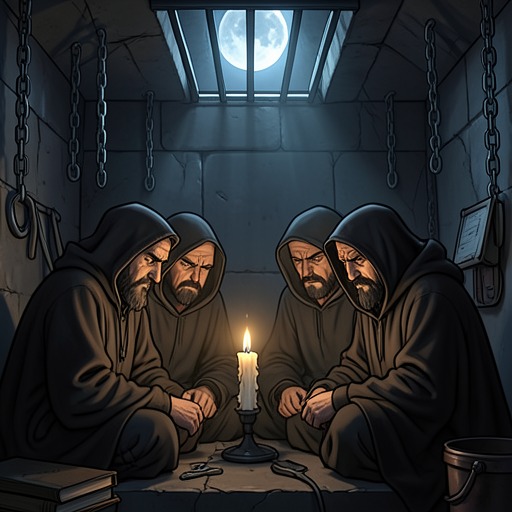
Her treatment of the courts varied according to obedience. Some High Lords and their entire courts were kept Under the Mountain, where Amarantha could torment them at will. Those who swore allegiance, grovelled, and served her were permitted somewhat greater freedom to come and go. Tamlin's court was allowed to remain in the Spring Court only until the end of his curse, after which Amarantha seized Tamlin and most of the court and brought them Under the Mountain as subjects. This selective permission created the appearance of privilege while making every movement conditional on personal submission.
The regime also depended on intermediaries and peripheral coercion. Amarantha gathered the most vicious creatures in Prythian and Hybern by offering sanctuary to those considered too terrible even for the Night Court. The Attor became one visible agent of this order. Her power extended beyond the captive courts: reports from human borderlands described faeries crossing the Wall to attack villages, and the evidence that faeries could not cross without permission made those attacks appear sanctioned from above. The mortal territory, already too poor to maintain a standing army, relied on the Treaty and on hired swords, charms, iron, and threshold markings that offered little more than an illusion of safety.
Law, Bargains, and Arbitrary Power
The Treaty still structured the relationship between the Mortal Realm and Prythian. Its terms required a human life in payment for an unprovoked human attack on faerie-kind, a rule that explains why Feyre Archeron becomes vulnerable after killing Andras. Yet under Amarantha, treaty law does not restrain sovereignty; it becomes another instrument that can be invoked selectively. The old legal distinction between provoked and unprovoked violence remains intelligible, but the ruler who controls punishment, captivity, and release controls the practical meaning of justice.
That transformation is clearest in Amarantha's bargain with Feyre Archeron. She offers to release Tamlin if Feyre completes three tasks chosen by Amarantha, presenting the trials as a test of human loyalty, love, and worthiness. Feyre expands the bargain to include the breaking of Tamlin's curse and the freedom of his court, attempting to close possible loopholes through precise language. Amarantha also offers a riddle as an alternative escape: Feyre may answer it at any time, but an incorrect answer will bring the fate represented by Clare Beddor's death. The bargain gives coercion a legal form while ensuring that its terms remain embedded in torture and spectacle.
When Feyre survives the trials and solves the riddle, Amarantha refuses to honor the apparent immediacy of the promised freedom. She argues that Feyre had not specified when the court must be released, claiming the power to delay liberation until some later moment, perhaps after Feyre's death. The episode exposes the regime's central legal fiction: a promise can be formally made, publicly witnessed, and still be emptied of protection when the sovereign controls interpretation. Amarantha's rule is therefore an exception made permanent, in which law exists but cannot stand against personal discretion.
The Blight and the Politics of Fear
The condition of Prythian under Amarantha is first misrecognized as a supernatural sickness. Reports reach the Spring Court that the blight has killed two dozen younglings in the Winter Court, burning through their magic and then breaking apart their minds. Other courts are also being struck, while the Night Court remains untouched. The spreading devastation appears ecological and magical at once, moving farther south with each attack and producing grief that no court can contain.
Alis reveals that the blight is Amarantha herself. The borders are collapsing because she has deliberately reduced them to rubble, and she sends creatures into the lands to test whatever strength Tamlin has left. What looks like an impersonal disaster is thus a policy of attritional violence: the ruler weakens territories, exposes their defenses, and allows suffering to be experienced as natural calamity rather than identifiable political action. The deaths of younglings make the regime's violence generational as well as military, destroying the future capacity of the courts while their rulers remain trapped.
This manufactured crisis also threatens the mortal world. Amarantha has spent forty-nine years consolidating power and waiting for the moment to break the Treaty, conquer the human lands, and continue against the territories beyond them. Her army is being assembled from lethal faeries in both Prythian and Hybern, and her sanction appears behind increasing attacks across the Wall. Even the human stories surrounding Clare Beddor and her family are understood as part of this broader apparatus of terror, in which the boundary between realms becomes a controlled frontier rather than a protection.
Collapse and Aftermath
The regime's apparent permanence begins to fracture when Feyre Archeron completes the trials and answers Amarantha's riddle. Tamlin and Rhysand are present as embodiments of different forms of constrained power: Tamlin remains physically formidable but is weakened, while Rhysand can seize Feyre Archeron's body and mind so completely that her blood moves according to his will. Such scenes show that even resistance operates inside a world where magic can override bodily autonomy, and where rulers are measured by how they use power over other bodies.
Amarantha's final attempt to preserve control is openly contemptuous. After Feyre's victory, she insists that release can occur whenever she sees fit and threatens to kill Feyre. The crowd's demand that the captives be freed reveals a limit to her authority: public recognition begins to separate victory from obedience. Yet the ruler still acts through violence, and a force more violent than lightning strikes Feyre before she can escape. The ending of Prythian under Amarantha's Rule is therefore not a clean restoration of lawful order. It is the exposed failure of a regime that has made every promise conditional, every border penetrable, and every apparent disaster political.